Logo
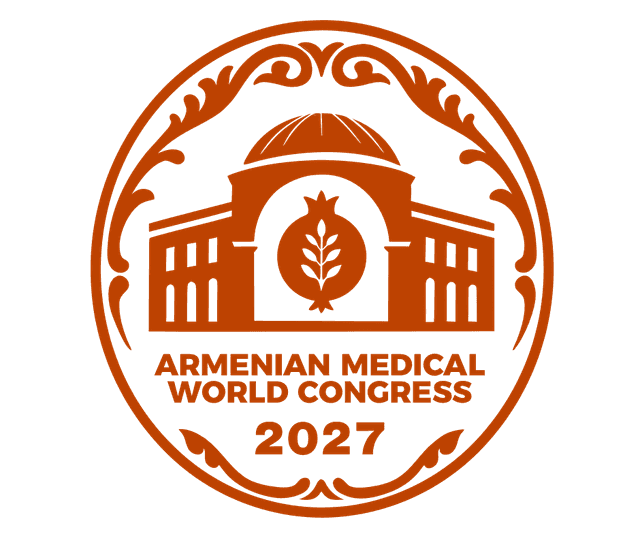
The logo of the Congress reflects the roots of Armenian medicine and the leading trends of the modern world. The main color of the emblem is Armenian clay, Bolus Armeniacus. Its antiseptic and wound-healing properties were mentioned as early as Avicenna's works. The choice of the silhouette of the logo is also symbolic. The oldest known object made of Armenian clay is a lamp made by Armenian potters of the settlement of Iznik in 1552, which is kept in the Victoria and Albert Museum of London. The illustrations of the lamp later inspired Armenian potters to create the decorations of the interior of the external walls of the Cathedral of the Holy Resurrection. Therefore, the silhouette of the emblem refers to the medieval applied art created by Armenian potters from healing Armenian clay. The main components of the emblem are two. The first is the domed building of the Medical University, as a direct reference to the fact that the inviting party of the Congress is the Yerevan State Medical University. The second important element is the pomegranate, which in Armenian culture symbolizes life, regeneration, and fertility. Even in his works, the great medieval Armenian physician Mkhitar Heratsi mentioned the antipyretic tincture and the ointment that stopped bleeding made from pomegranate peel. The connection with the modern world is symbolized by the pomegranate seeds, which are connected to each other like a microcircuit, expressing the interconnection of medicine, innovative technologies, and artificial intelligence. At the same time, the seeds symbolize the people who are united by the Congress, creating a common platform for knowledge, experience, and cooperation.
Download Brandbook
Get the Congress brandbook with logo versions, colors, typography, and usage guidelines in a single PDF.